
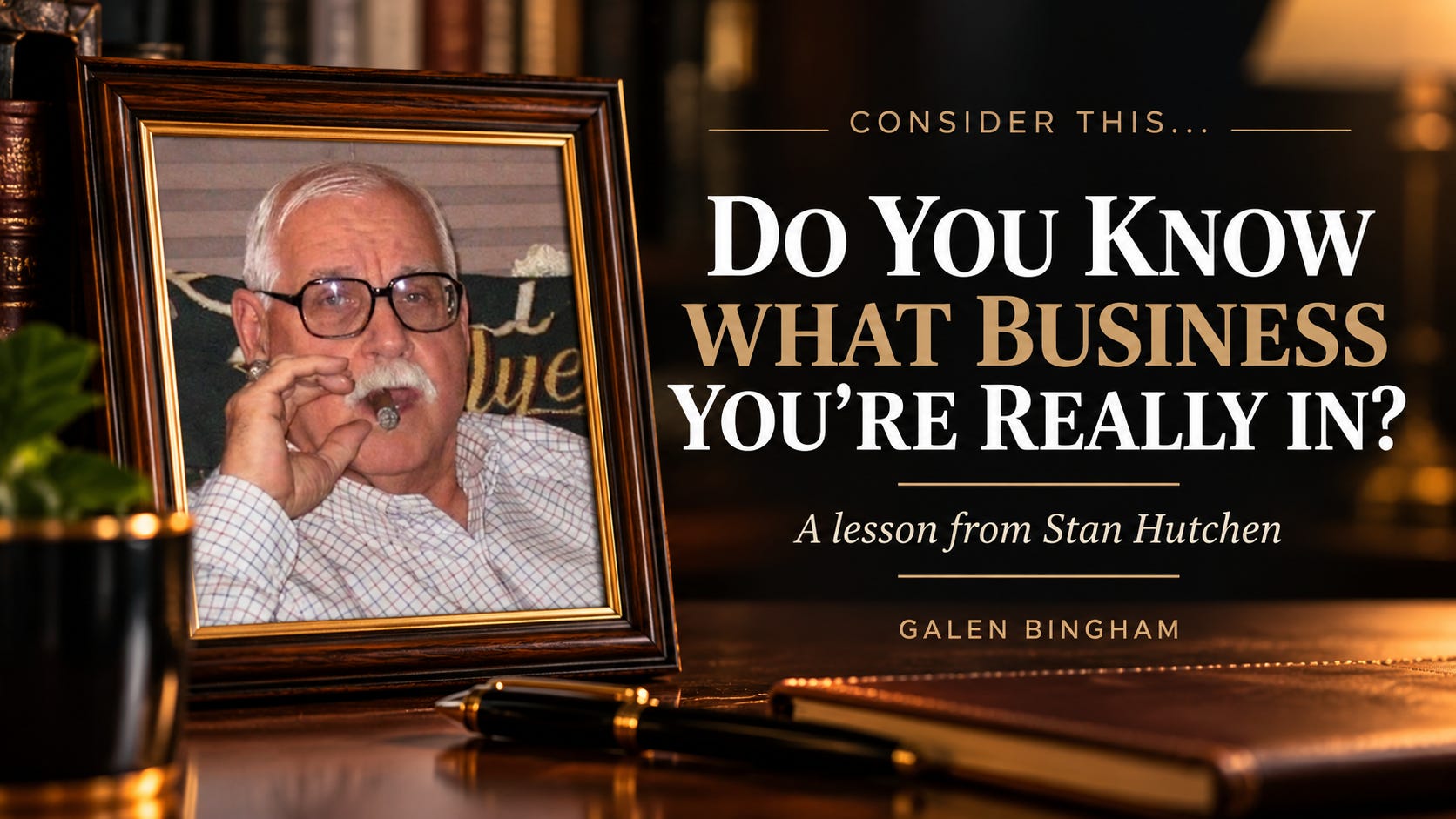
“Do you know the business you’re in?”
That was one of my longtime Coca-Cola mentor Stan Hutchen’s favorite questions to ask new managers. Seems simple enough, doesn’t it? You’d be surprised how many accomplished executives struggled to answer it.
Now, you have to understand something about Stan. Around Coca-Cola, he was known as “Stormin’ Stan.” He was sharp, demanding, and had very little patience for puffery. When he asked a question, he wasn’t looking for some rehearsed corporate answer. Of course, that didn’t stop people from trying. They’d start talking about the beverage industry, our brands, our customers, or the competitive landscape. All things they knew plenty about. None of which answered his question.
Stan wasn’t asking what we sold. He wanted to know whether we understood the value we were there to create. We were in the value creation business.
Stan had a simple way of thinking about value. What did people receive compared to what they expected? And he wasn’t just talking about customers and consumers. Employees mattered, too. If you delivered what people expected, you’d done your job. But what did they get that they hadn’t counted on? What became possible because you were involved? That’s where Stan wanted our attention.
Recently, I heard former Pittsburgh Steelers head coach Mike Tomlin make a similar distinction. “Football is our game, but our business is winning.” I smiled when I heard it because it immediately reminded me of Stan. Different profession, same lesson.
You can become exceptionally good at the activities associated with your job and still lose sight of what you’re actually there to accomplish. I’ve seen that happen to some very talented executives. Think about the leader whose calendar is packed from morning until evening. Meetings, presentations, performance reviews, strategic planning sessions. The team is busy. The numbers look good. The organization is pleased. Nothing appears to be wrong. But I wonder what would happen if we asked that leader Stan’s question. Not what you do or what you’re responsible for. What business are you really in?
I’ve known managers who took great pride in being indispensable. Everybody brought their problems to them, and they always had an answer. Their bosses loved it. But I’ve always wondered what those managers thought would happen when they got promoted. If nobody on your team can make a decision without you, exactly what have you been developing?
Here’s the irony. That manager could be the highest-rated leader in the organization while building a team that’s increasingly dependent on them. Not because the manager isn’t talented, but because the organization keeps rewarding the wrong contribution.
I’m not minimizing the importance of delivering results. I’ve spent enough years carrying a number and managing a P&L to know that results matter. But I’ve also been around long enough to recognize something else. Sometimes the expectations you’re being rewarded for meeting are the very expectations you ought to be challenging. You could be doing exactly what your boss wants, receiving outstanding performance reviews, and getting promoted for behaviors that actually limit the value you could create.
All of which got me thinking about how I’d answer Stan’s question today. For years, I’ve introduced myself as an executive coach, leadership strategist, speaker, and advisor. All accurate descriptions of my work. But Stan wasn’t asking about the work.
Most of the executives I work with are already accomplished. They don’t need another person telling them to work harder. Sometimes they need someone willing to question the assumptions that helped make them successful. I’ve had coaching conversations where the most valuable thing I contributed wasn’t an answer. It was a question that helped an executive see something differently. And once they saw it differently, they made a different decision.
After 35 years, Stan retired from Coca-Cola in 2001. He passed away in 2020, before he had the chance to see the work I’m doing today at Kiln Global. And here I am, all these years later, still thinking about the lessons he made sure his managers understood.
I wonder what he’d think if we had that conversation today. I can almost picture him sitting across from me, asking that familiar question. “Do you know the business you’re in?” This time, I wouldn’t hesitate.
My work is leadership. My business is perspective.
I expand perspective so leaders can make better decisions when the stakes are highest. And knowing Stan, I think he’d smile. Because he wasn’t just teaching us how to create value for the company. He was creating value in us.
Three Things to Consider
If you couldn’t use your title, industry, or job responsibilities, how would you describe the business you’re really in?
Where might you be getting rewarded for meeting expectations that actually deserve to be challenged?
What could you make possible for the people you serve that they haven’t even thought to ask for?
Consider This.
#ExecutiveLeadership #ExecutiveCoaching #LeadershipDevelopment #HighPerformanceLeadership