
Do you ever feel responsible for problems that aren’t yours?
Do you replay conversations that haven’t happened yet?
Do you find yourself scanning every room for what could go wrong?
Do you have a hard time turning your mind off because some part of you is always standing watch?
For years, I thought those instincts were leadership.
I don’t anymore.
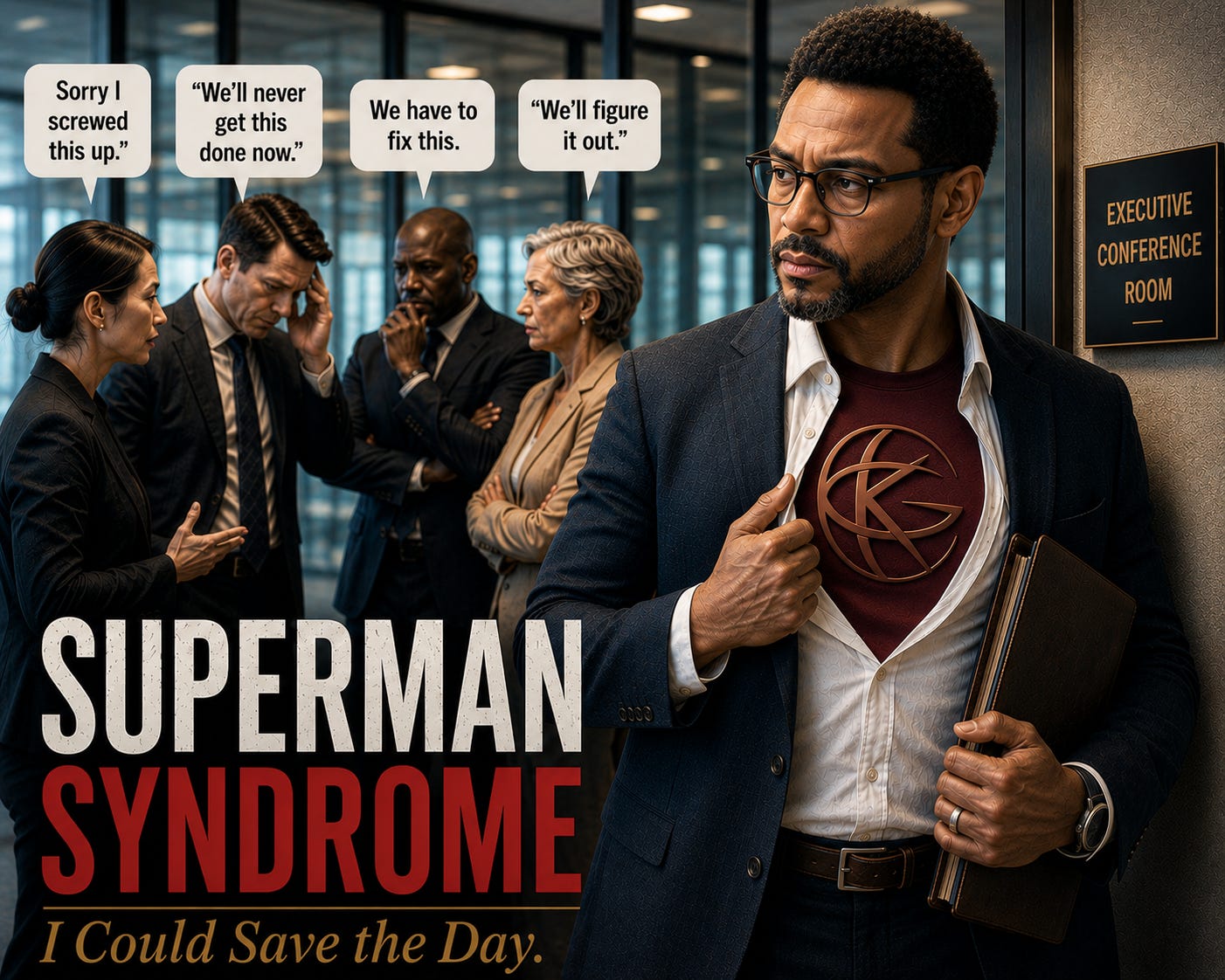
I’ve come to call the pattern Superman Syndrome.
Not the medical condition.
It’s a leadership pattern. The unconscious habit of accepting responsibility for outcomes that were never yours to own.
Looking back, I know exactly where mine began.
I’m the oldest of three children. I loved being the big brother. Protecting people didn’t feel like a burden.
It felt like love.
Somewhere along the way, I never stopped expanding the definition of family.
It started with my brother and sister.
Then my teammates.
Then my friends.
Then my church community.
Then my fraternity brothers.
Eventually, almost anyone within reach.
The strange thing is that nobody told me to stop.
If anything, they rewarded it.
Teachers trusted me.
Coaches relied on me.
Corporate America promoted me.
Looking back, I wasn’t always being rewarded for carrying healthy responsibility.
Sometimes I was being rewarded for carrying responsibility that didn’t belong to me.
The line kept moving until I couldn’t tell where my responsibility ended and someone else’s began.
If you happened to be eating in the same restaurant I was, some part of me quietly assumed your safety had become my concern.
If we happened to be on the same airplane, I was already thinking about what I would do if something went wrong.
I realize how that sounds.
Unfortunately, my nervous system didn’t.
It simply kept doing what it had learned to do decades earlier.
Always scan.
Always anticipate.
Always be ready.
It wasn’t corporate America that exposed the blind spot.
Coaching did.
One of the first things we’re taught as professional coaches is not to help until we’ve been invited.
I hated that idea.
If I can help, why wouldn’t I?
Then one sentence changed everything.
When a surgeon operates without a patient’s consent, it’s malpractice.
Not because leadership is surgery.
Because the principle is the same.
Just because you see a problem doesn’t mean you’ve been invited to solve it.
Seeing a need does not create an assignment.
Capability does not create assignment.
Those two ideas changed the way I coach.
More importantly, they exposed how often I still struggle to live them.
Almost every week, an executive tells me they’re exhausted.
At first, they blame the workload.
As we keep talking, something else usually appears.
They’re carrying people.
Carrying decisions.
Carrying conflict.
Carrying outcomes.
Not because anyone asked them to.
Because somewhere along the way, they quietly decided that’s what leadership requires.
A few years ago, I coached an executive who planned a European vacation with his family.
Two days before they were supposed to leave, a major project reached a critical point.
He stayed.
His family left without him.
Five days later, after the project was finished, he joined them in Europe.
The project generated millions of dollars.
Everyone agreed he’d made the right decision.
Maybe he did.
But that’s no longer the question that interests me.
Did the project succeed because he stayed?
Or did the organization simply become more convinced it couldn’t succeed without him?
We’ll never know.
He never gave them the chance.
For a long time, I saw that story as an example of commitment.
Now I wonder if it’s also an example of Superman Syndrome.
Every successful rescue becomes evidence that you should rescue again.
That’s the trap.
And if I’m honest...
I still catch myself.
My clients begin to feel painfully familiar.
I recognize the pressure.
I recognize the loneliness.
That’s when I have to be most careful.
The thought still shows up.
I could save the day.
Sometimes it arrives before they’ve even finished explaining the problem.
It’s almost embarrassing to admit.
Especially for someone who coaches leaders for a living.
I know better.
Sometimes I just don’t do better.
The difference today isn’t that the impulse has disappeared.
The urge to reach for the cape is always there. Most days, I catch myself before I put it on.
Some days I don’t.
I’m still learning that those are two very different ways to lead.
If this sounds familiar, here are four practices that are helping me interrupt the pattern.
First, separate capability from assignment.
Before you step in, ask yourself one question.
Is this actually my assignment?
Second, replace answers with questions.
Questions build capability.
Rescuing builds dependency.
Instead of offering your solution first, ask:
“How are you thinking about this?”
“What options have you considered?”
“What outcome are you hoping to create?”
Third, turn your phone off.
Not silent.
Not vibrate.
Off.
Start with one hour in the middle of the day. Perhaps over lunch.
Don’t do it to test your organization.
Do it to test your assumptions.
If your organization truly can’t function without you for an hour, you have an organizational design problem.
If it can, but you still feel internal resistance, ask yourself why.
Finally, let people own the outcome.
Let them struggle.
Let them recover.
Let them surprise themselves.
Every time we rescue someone too early, we borrow confidence from a future version of themselves.
I still ask myself one question before I volunteer.
Is this actually my assignment?
More often than I expected, the answer is no.
I wish I could tell you I’ve outgrown Superman Syndrome.
I haven’t.
The urge to reach for the cape is always there. Most days, I catch myself before I put it on.
Maybe that’s what growth looks like.
Not perfection.
Just noticing the impulse before it quietly becomes your identity.
Questions to Sit With
Where have you accepted responsibility for outcomes that were never yours to own?
Who are you rescuing instead of developing?
What would change if you separated capability from assignment?
Power is built. Never granted.
#ExecutiveLeadership #ExecutiveCoaching #LeadershipDevelopment #SelfLeadership #LeadershipUnderPressure #KilnGlobalCoaching