Most people think executive leadership is about having answers.
The executives I know lose sleep because of the questions.
Questions that don’t stay at the office.
Questions that affect customers, employees, investors, careers, and families.
Questions where every option creates consequences.
From the outside, leadership looks like authority.
From the inside, it feels like responsibility.
The responsibility to decide when the data is incomplete.
The responsibility to act when every option carries risk.
The responsibility to remain steady while everyone around you wants certainty.
That’s why executive leadership is ultimately not a test of intelligence.
It’s a test of judgment.
And judgment is constantly under pressure.
Over the next three articles, we’ll explore why pressure narrows perspective, how leaders lose access to their best thinking, and what separates executives who make sound decisions from those who become trapped by the pressure surrounding them.
The Hidden Threat to Executive Judgment
Pressure rarely announces itself.
It doesn’t walk into the room and declare its intentions.
Instead, it quietly begins narrowing what leaders can see.
It makes today’s problem appear larger than tomorrow’s opportunity.
It shortens time horizons.
It amplifies urgency.
It rewards reaction over reflection.
Left unchecked, pressure doesn’t just distort decisions.
It distorts the decision-maker.
The best leaders I’ve known weren’t always the smartest people in the room.
They were the people most capable of maintaining perspective while everyone around them were losing theirs.
If you’re reading this, you’re probably carrying a decision right now.
A conversation.
A strategy.
A risk.
A commitment.
You’ve reviewed the facts.
You’ve weighed the options.
Yet something still feels unresolved.
Not because you lack capability.
Because pressure has a way of interfering with access to your best thinking.
Strategic Agency
I’ve come to believe that one of the most important leadership capabilities is what I call Strategic Agency.
Strategic Agency widens perspective.
It’s the ability to maintain access to your best thinking when pressure is trying to take it away.
It’s the discipline to separate the pressure surrounding a decision from the decision itself.
It’s the ability to remain connected to long-term consequences while everyone else is reacting to short-term discomfort.
In my experience, the quality of a leader’s decisions rarely exceeds the quality of their perspective.
Which is why I’ve come to believe a simple truth:
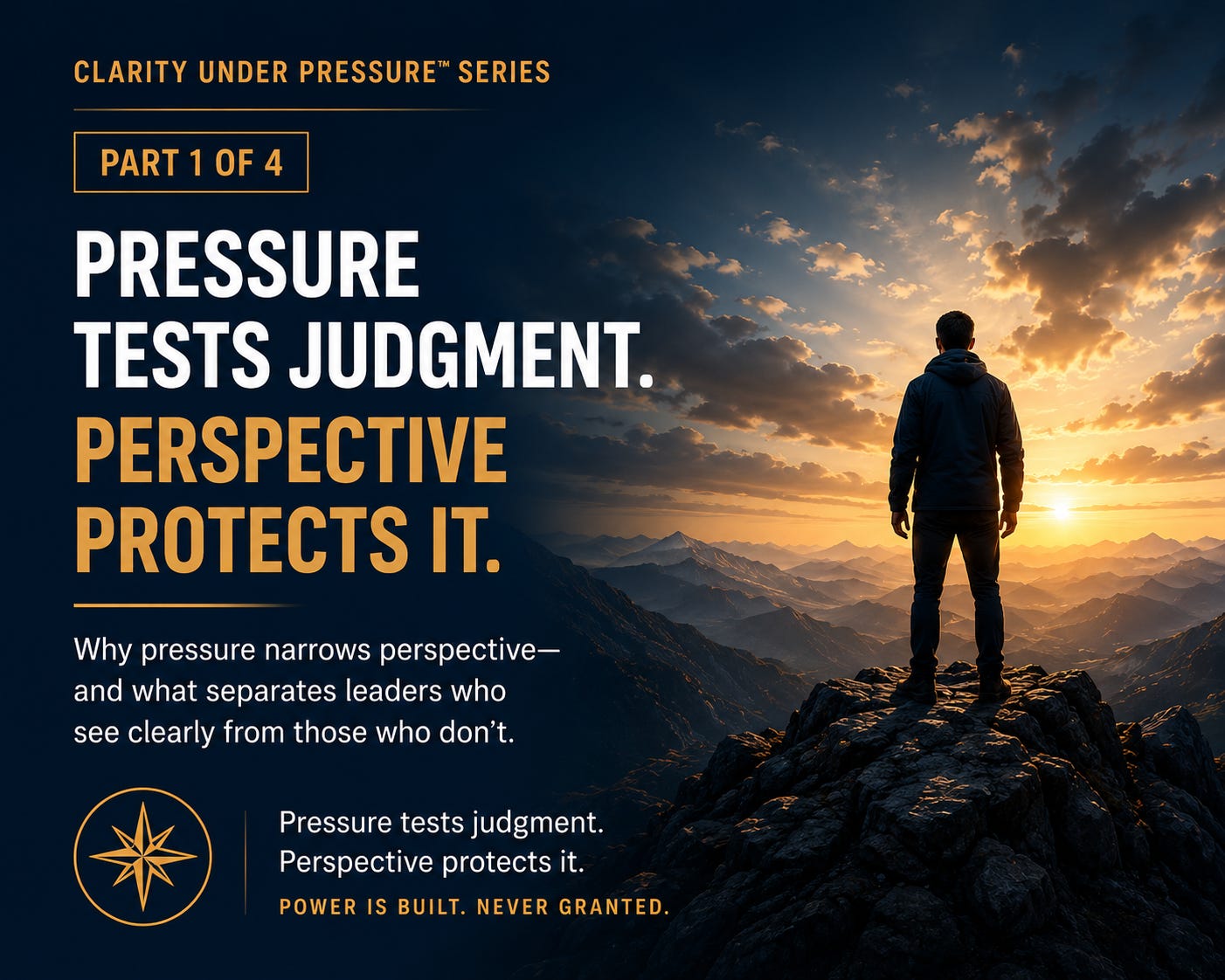
Pressure tests judgment. Perspective protects it.
The Day Perspective Changed Everything
One of the most consequential decisions of my career came during my time as National Director of Foodservice Sales at Imperial Sugar Company.
A weather-related crisis disrupted sugar production across the industry.
Two major competitors went offline.
Demand exceeded supply.
Every constituency wanted answers.
Customers wanted answers.
Distributors wanted answers.
Senior leadership wanted answers.
Like most pressure, the crisis narrowed the conversation.
Who gets sugar?
How much do they get?
What do we charge?
Those were important questions.
But they weren’t the most important questions.
The shortage would end.
Competitors would return.
The real question was:
What decision would still be serving us after the crisis was over?
I challenged our team to evaluate two horizons simultaneously.
What decision creates the best outcome during the crisis?
What decision creates the best outcome after the crisis?
That shift in perspective changed everything.
It led to the first national pricing structure in company history, three- to six-year customer commitments, and a fundamental rethinking of how contracts were structured throughout the industry.
The crisis ended.
The advantages remained.
Looking back, the challenge wasn’t the shortage.
The challenge was the pressure surrounding the decision.
Most leaders use a crisis to protect the present.
Great leaders use a crisis to position the future.
The lesson had nothing to do with sugar.
It had everything to do with perspective.
Three Sources of Pressure
Over the years, I’ve noticed that most executive decisions are shaped by three forms of pressure.
Enterprise Pressure
The pressure created by decisions whose consequences extend far beyond your immediate area of responsibility.
Political Pressure
The pressure created by competing agendas, influence, and stakeholder interests.
Economic Pressure
The pressure created by the financial, personal, and identity-based consequences attached to a decision.
Each narrows perspective in a different way.
Each can quietly distort judgment.
And each requires leaders to expand their perspective before expanding their action.
We’ll explore the last two in the next articles.
Where We’re Going Next
In this article, we’ve explored a simple idea:
Pressure tests judgment. Perspective protects it.
We’ve also explored why leaders need more than information.
They need perspective.
Because perspective is what allows leaders to see beyond the pressure of the moment.
In Part 2, we’ll explore one of the most common traps successful leaders face:
Why so many talented executives can calculate the cost of change, yet rarely calculate the cost of staying the same.
Because some of the most expensive decisions leaders make are not the decisions they make.
They’re the decisions they postpone.
Three Questions to Consider
Which of your current decisions is being shaped more by pressure than by perspective?
If the pressure disappeared for the next thirty minutes, what decision would suddenly become obvious?
If you created space for a broader perspective, who would you need to become to lead this situation at your highest level?
Power is Built. Never Granted.
#ClarityUnderPressure #PerspectiveShift #LeadershipResilience #ExecutiveMindset #StrategicAgency