You’re probably thinking:
“Wait a minute.
We’ve spent the last three weeks talking about pressure.
Now you’re telling me pressure wasn’t the real problem?”
Well...
Yes and no.
The pressure was real.
The budget cuts were real.
The difficult conversations were real.
The uncertainty was real.
The consequences were real.
What wasn’t always real was the meaning we assigned to the pressure.
And that’s where things get interesting.
Throughout this series, we’ve explored how pressure narrows perspective, distorts risk, and clouds responsibility.
And it certainly feels that way when you’re living through it.
But over the years, I’ve noticed something interesting.
Two executives can face the same pressure and arrive at completely different conclusions.
One becomes paralyzed.
The other becomes decisive.
One becomes defensive.
The other becomes curious.
One sees threat.
The other sees possibility.
Same pressure.
Different outcome.
That’s when I began to realize something.
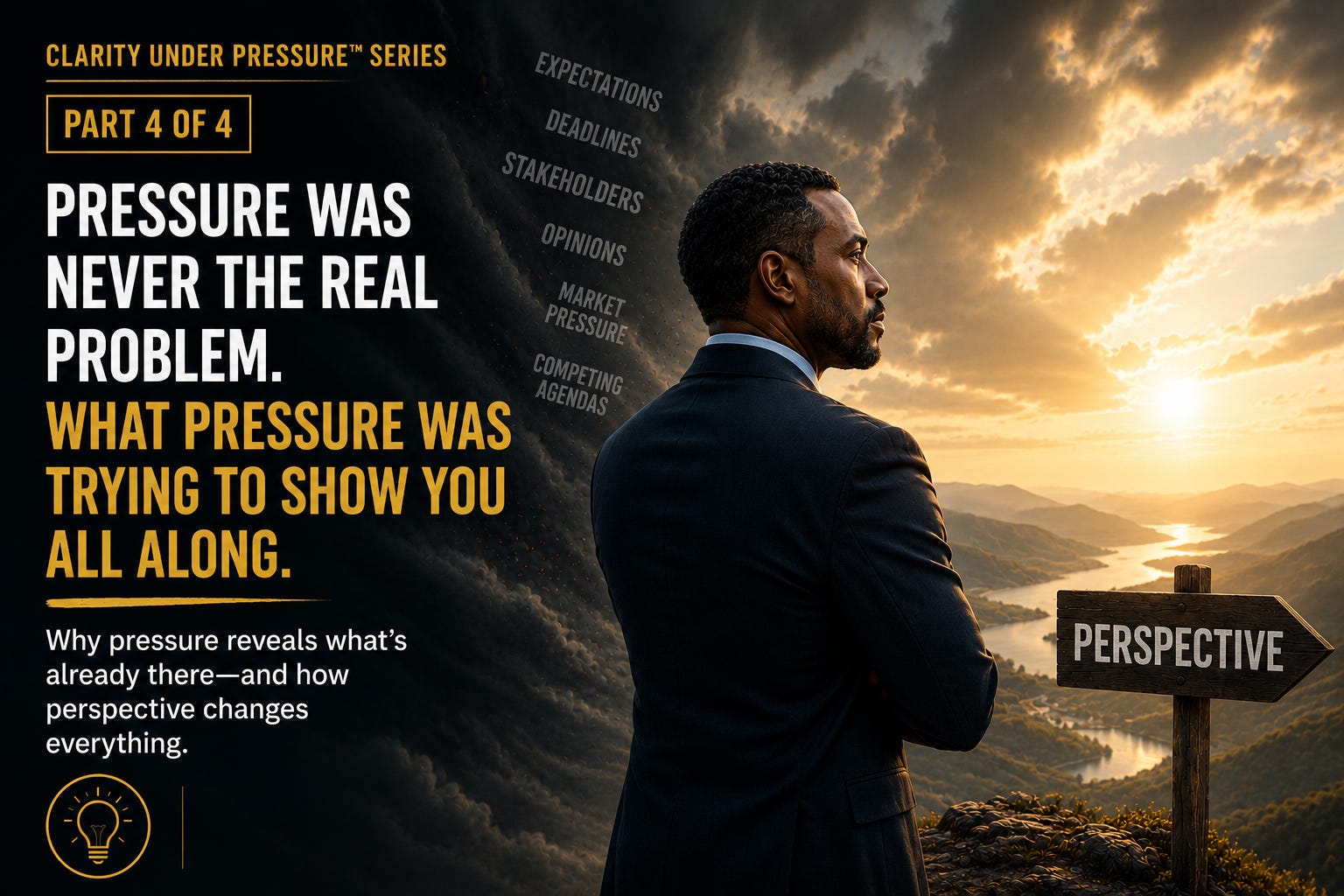
Pressure wasn’t creating the distortion.
It was revealing it.
Two Executives. Same Pressure.
Over the years, I’ve watched executives face remarkably similar circumstances.
One leader sees a budget cut and immediately starts protecting territory.
Another sees the same budget cut and starts looking for opportunity.
One leader sees organizational change and immediately worries about job security.
Another sees the same change and starts evaluating strategic possibilities.
One leader enters a difficult meeting and becomes defensive.
Another enters the same meeting and becomes curious.
Same pressure.
Different response.
Why?
Because pressure wasn’t determining their behavior.
Perspective was.
Pressure simply revealed it.
What Economic Pressure Revealed
In Part 2, we met the executive who had achieved everything she’d worked for.
The title.
The compensation.
The influence.
From the outside, it looked like success.
Yet every Sunday afternoon, she sat in her driveway trying to delay Monday.
The economic pressure wasn’t the real problem.
The pressure revealed something she’d been avoiding.
She no longer wanted the future she’d built.
The pressure simply made that reality impossible to ignore.
What Political Pressure Revealed
In Part 3, we met the executive facing a billion-dollar decision.
Everyone had opinions.
Everyone had preferences.
Everyone had interests.
The political pressure wasn’t the real problem.
The pressure revealed something else.
He had started carrying priorities that weren’t his.
Once he recognized that, clarity returned.
Not because the pressure disappeared.
Because the distortion did.
What Pressure Reveals About Us
Pressure has a way of forcing a conversation we’d rather avoid.
A conversation about what we believe.
About what we fear.
About what we’re unwilling to examine.
Pressure reveals whether we’re protecting comfort or pursuing purpose.
Pressure reveals whether we’re managing reactions or stewarding outcomes.
Pressure reveals whether we’re operating from conviction or accommodation.
Most of all, pressure reveals the quality of the perspective we’re bringing to the moment.
The Real Work
That’s why the goal isn’t to eliminate pressure.
Good luck with that.
The higher you rise, the more pressure you’ll encounter.
The goal is to develop the perspective necessary to navigate it.
Because pressure will test your judgment.
Perspective will protect it.
Pressure will test your courage.
Perspective will protect it.
Pressure will test your leadership.
Perspective will protect it.
That’s been the point of this entire series.
The executives who navigate pressure most effectively aren’t the ones with less pressure.
They’re the ones who see it differently.
The Question Behind Every Pressure-Filled Moment
The next time you feel pressure building, pause before asking:
“How do I get rid of this?”
Instead ask:
“What is this pressure trying to show me?”
That question changes everything.
Because more often than not, the pressure isn’t the problem.
It’s the invitation.
The invitation to see something you’ve been missing.
The invitation to challenge an assumption.
The invitation to expand your perspective.
And ultimately, the invitation to lead differently.
Looking Back
Looking back, pressure was never the real problem.
Not economic pressure.
Not political pressure.
Not performance pressure.
Not uncertainty.
Pressure simply revealed what was already there.
It revealed how we viewed risk.
It revealed what responsibilities we were carrying.
It revealed the assumptions we hadn’t challenged.
It revealed the quality of our perspective.
That’s why the goal was never to eliminate pressure.
The goal was to expand perspective.
Because expanded perspective changes what we see.
What we see influences the decisions we make.
And the decisions we make ultimately shape the results we experience in our work and our lives.
The challenge was never the pressure.
The challenge was whether we had enough perspective to understand what the pressure was trying to show us.
Because pressure tests judgment.
Perspective protects it.
Three Questions to Consider
1. What has pressure been trying to show you that you’ve been unwilling to see?
2. Where have you been blaming pressure for something that actually requires perspective?
3. Where might your perspective be limiting what you can see, and what decisions might be suffering as a result?
Pressure tests judgment. Perspective protects it.
Power is Built. Never Granted.
#ClarityUnderPressure #PerspectiveIsPower #ExecutivePresence #LeadershipResilience #StrategicAgency