
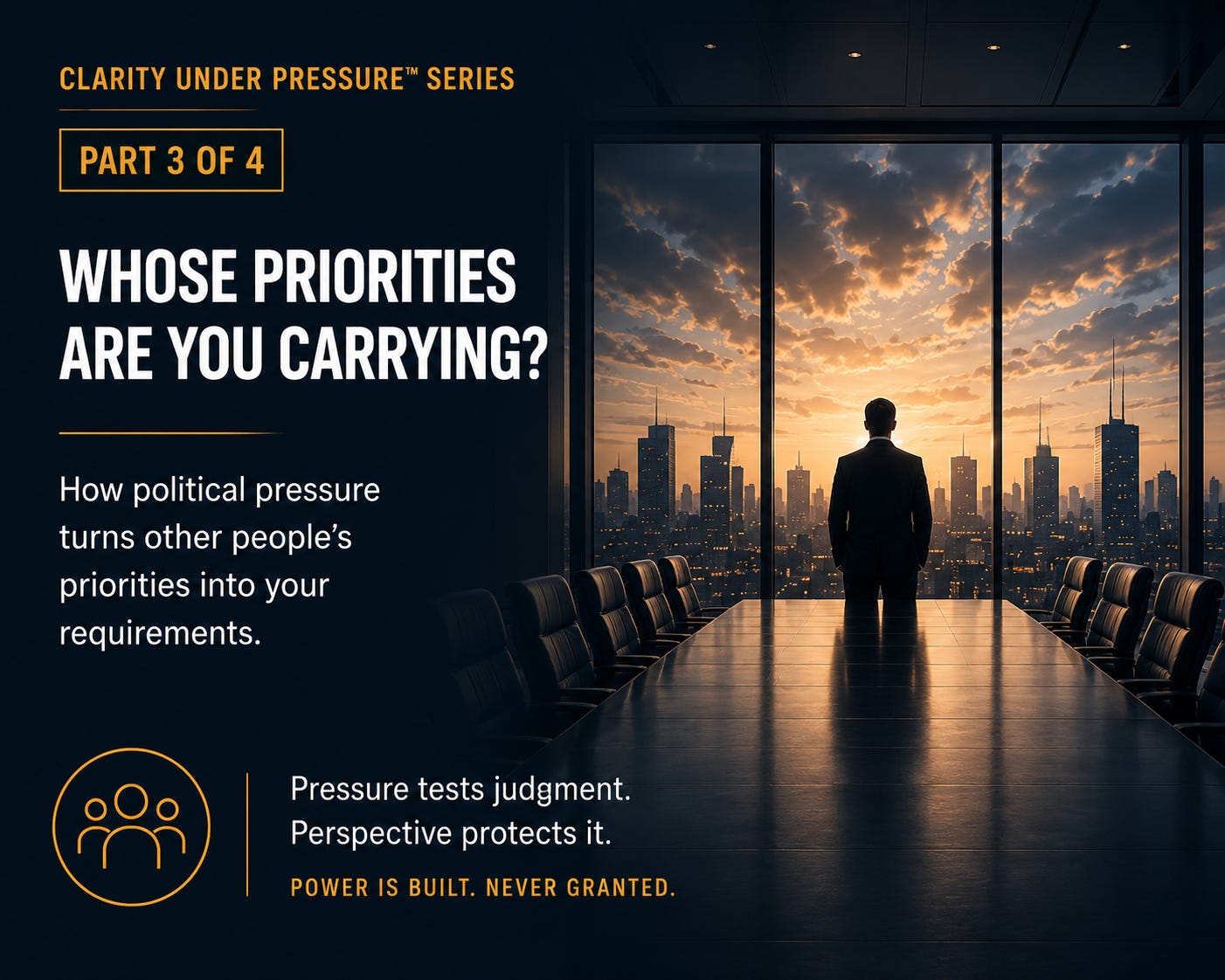
When was the last time you walked into a meeting convinced the right decision was obvious...
Only to leave wondering how it became so complicated?
The facts didn’t change.
The options didn’t change.
The desired outcome didn’t change.
What changed was the number of people who suddenly had an interest in the outcome.
If you’ve led long enough, you’ve experienced this.
In fact, when I describe this scenario to my coaching clients, most don’t hesitate.
They usually laugh.
Then tell me it happened this week.
Some tell me it happened this morning.
Not because the decision was difficult.
Because the politics surrounding it made it feel that way.
You expected to discuss a decision.
Instead, you found yourself navigating agendas.
Personal agendas.
Department agendas.
Political agendas.
By the time the conversation ended, you realized something important.
The pressure surrounding the decision had become louder than the decision itself.
Most new leaders make themselves a promise.
“I won’t let politics influence my decisions.”
It’s an admirable goal.
It’s also unrealistic.
Politics enter nearly every consequential decision whether we want them to or not.
The bigger the decision, the more likely it is that someone will have a preferred outcome.
The stakes create interests.
And interests create politics.
The question isn’t whether political pressure will appear.
It will.
The question is whether you’ll recognize when someone else’s priorities begin feeling like your requirements.
Political pressure is what happens when someone else’s priorities begin masquerading as your requirements.
That’s what makes it so difficult to recognize.
The pressure doesn’t arrive looking political.
It arrives looking important.
Before long, leaders find themselves carrying expectations they never consciously agreed to own.
Three Weeks In
Several years ago, I worked with a senior executive facing one of the most significant decisions of his career.
Three weeks into a new role, he found himself responsible for a decision that would influence nearly a billion dollars in revenue.
Many of the people affected by the decision were individuals he had not yet met.
Yet everyone seemed certain about what he should do.
As the discussions continued, the focus slowly moved away from the decision itself.
And toward the people surrounding it.
At one point he looked around the room and realized something uncomfortable.
This decision would impact everyone in the room.
No one was shy about explaining how.
Nearly everyone had an opinion.
Nearly everyone would leave the room believing they’d influenced the outcome.
Nearly everyone would move on to their next meeting.
He was the one who’d still own the consequences six months later.
In that moment, the room looked different.
The debate looked different.
The decision looked different.
Everyone else was discussing possibilities.
He was calculating consequences.
Everyone else had influence.
He had accountability.
And yet, the pressure in the room was trying to convince him that everyone else’s priorities deserved equal weight.
The decision wasn’t the problem.
Figuring out which priorities actually belonged to him was.
When Priorities Become Requirements
Political pressure rarely arrives looking like politics.
It sounds like:
“We need to keep them happy.”
“This isn’t the hill to die on.”
“Let’s not create unnecessary friction.”
“Have we thought about how they’ll react?”
Reasonable statements.
Until you realize nobody’s talking about the decision anymore.
They’re talking about the reactions to the decision.
That’s when things get dangerous.
Political pressure is what happens when someone else’s priorities begin masquerading as your requirements.
You’ve probably seen it.
Maybe you’ve lived it.
Somewhere along the way, leaders stop evaluating expectations and start carrying them.
That’s a costly mistake.
Because not every expectation belongs to you.
Not everyone in the room owns the outcome.
Everyone may have influence.
Not everyone owns the consequences.
Strong opinions don’t transfer responsibility.
Strong personalities don’t transfer responsibility.
Strong relationships don’t transfer responsibility.
The outcome still belongs to the person holding the decision rights.
Influence without accountability is noise.
Accountability without perspective is danger.
What Changed
The breakthrough didn’t come from new information.
It came from clarity.
He stopped managing opinions.
And returned to stewarding outcomes.
Once he did, the path became obvious.
Not easy.
But obvious.
That’s what perspective does.
It helps us separate what we should consider from what we should carry.
The Stewardship Question
The higher leaders rise, the more opinions they encounter.
That isn’t going to change.
The real question is whether those opinions improve their thinking or replace it.
Leadership is not a popularity contest.
It is a stewardship responsibility.
Some people will disagree with your decisions.
Some will question them.
Some will be disappointed by them.
That comes with the territory.
Leadership becomes dangerous the moment leaders become more committed to managing reactions than stewarding outcomes.
The responsibility of leadership is not to satisfy every stakeholder.
The responsibility of leadership is to steward the outcome.
And those are not always the same thing.
Because more often than not, the greatest burden leaders carry isn’t the decision itself.
It’s all the priorities they’ve picked up along the way.
Many of which were never theirs to carry in the first place.
Three Questions to Consider
1. Whose priorities are you carrying that were never yours to own?
2. Where have someone else’s preferences begun masquerading as your requirements?
3. What would change if you focused solely on stewarding the outcome rather than managing reactions?
Next week, the final part of this series reveals why pressure was never the problem in the first place.
Power is Built. Never Granted.
#ClarityUnderPressure #CorporatePolitics #StrategicAgency #ExecutiveLeadership #NavigatingAgendas